Checkout 2.0
Identifying customer friction in a B2B checkout flow
Role
In a nutshell
Background
Analytics data showed high drop off rates across all 4 stages of the checkout experience. We wanted to identify and better understand the points of friction in the current checkout flow. Based on this, we proposed a re-designed checkout experience that alleviates the identified pain points.
Approach
We reviewed the current user flow and compared it to competitors in the field. We complemented and backed our findings with Baymard's B2B checkout guidelines ↗. To incorporate the perspective of actual users, we analyzed session recordings of users that did not complete checkout.
Results
Our report comprised 61 issues with varying degrees of evidence, impact, and effort. Most critical friction points included the general information architecture, form fields ↗ for addresses ↗ and regulatory information.
Meta
First, what went well: There was a lot of room for improvement. Some issues were so obvious that our stakeholders were surprised no one had noticed them before. For example, there was no order summary displayed throughout checkout. These and design suggestions for minor visual changes were successfully implemented.
What was most interesting to me was that we were able to identify several critical friction points. The tax field, for example. In our session recordings, 58% of US customers dropped off at the Regulatory step, compared to 31% in other countries.
And here the process became bumpy. It was evident from the session recordings that there was something confusing about the tax field for users. My additional research led me to the underlying problem: US customers do not require to state a VAT number during checkout (as opposed to Europe-based customers). They do not even have ↗ a type of tax number called "VAT".
So I went on and reviewed the tax regulations for all the 37 eCommerce countries the company operated in. My design suggestions replaced the ambiguous "VAT/GST/TAX number" label with a country-specific term ↗ (e.g., "GST number" for Canada). I advised in which countries the field would need to be made optional. I spent a lot of time on it and I was sure that everyone would love it.
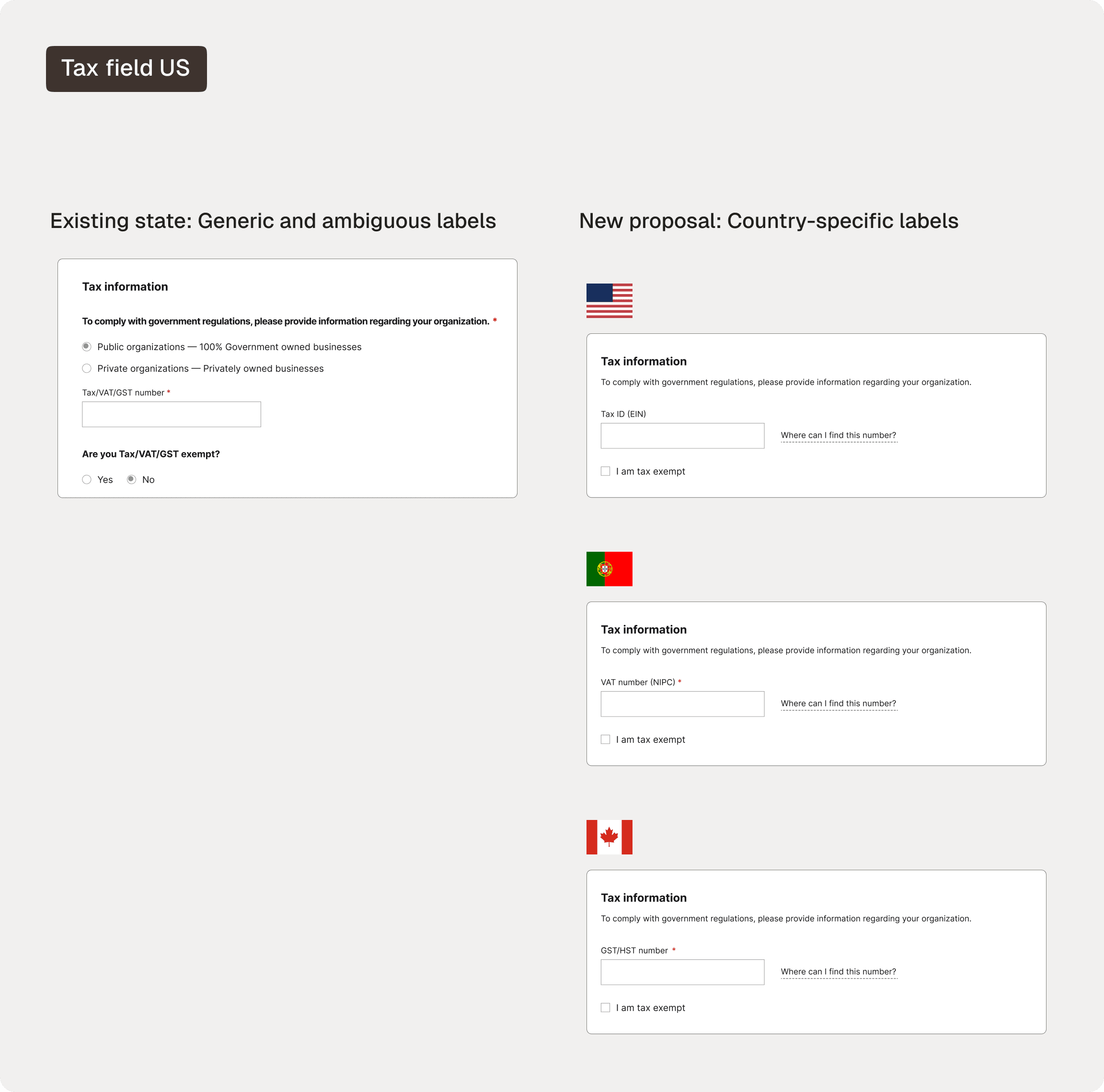
But I did not get the support I expected. Stakeholders were hesitant to stop obtaining data from a field that was previously mandatory. The concern was: someone somewhere in our organization might need this data for unknown reasons.
And this was my key takeaway from this project: There needs to be documentation that maps the flow of information ↗ for experiences such as checkout. A visualization ↗ of the relationships between data elements would help the team understand: Why are we asking for this data? Where does it go? Which systems or stakeholders use it? Because people don't take ownership of something they don't have the full picture of. And without that clarity, even the most valuable insights fail to turn into action.